Ashley Huntley
Mothering SundayAshley Huntley is a wealthy gentleman whose marriage to Lavinia Huntley is shaped by his demand for a male heir and his conviction that his wife’s wealth and body are at his disposal. He treats the birth of a son as a route to inheritance and standing, yet shows little tenderness toward the children whose existence he invokes. His order to dispose of his newborn daughter creates the secret that determines her life and keeps Lavinia ignorant of her own child for nearly sixteen years.
Identity and position
Ashley is portrayed as a man accustomed to leisure rather than work. His pursuits include drinking at his club, following horse-racing, gambling, and attending shoots. Lavinia’s money supports the manner of life he wants while he waits to become heir to his wealthy uncle’s fortune. The arrangement makes the imbalance in their marriage material as well as personal: Ashley depends on his wife’s resources, even as he insists that she owes him a son.
His standing also rests on his expectation that a healthy male child will secure his inheritance. He speaks of the hoped-for boy as a “fine healthy male,” while Lavinia’s three daughters, all stillborn, remain a source of grief for her rather than a reason for compassion from him. The contrast establishes the terms on which he values reproduction: a son matters as an heir; Lavinia’s losses do not alter his demands.
Marriage and the demand for an heir
After Ashley resumes sexual relations with Lavinia, he asks each month whether there is any sign of a child. She does not welcome the renewed intimacy, having learned that his charm conceals selfishness, but the pressure intensifies as his brother’s wedding approaches. His absences do not signal care or concern: he keeps a mistress in a cottage near town, paid for with Lavinia’s money, while returning to his wife when he wants another chance at producing an heir.
The marriage is marked by Ashley’s assumption of entitlement. On one occasion he comes to Lavinia’s room drunk and expects her to comply. She refuses, worried that she may be pregnant and unwilling to risk the possibility of a child. This is a rare direct assertion of her own judgment against his demands. The narrative presents their relationship not as a reconciliation but as a coercive arrangement in which Ashley’s wish for a son dictates the terms of intimacy.
His treatment of Lavinia extends beyond the private rooms of the marriage. When she returns from visiting a girl she had helped find work, Ashley tells her that her time would be better spent caring for children of her own and immediately asks whether she is pregnant. His rebuke reduces her charitable action to a distraction from the task he assigns her: bearing his child. At dinner with a guest, he likewise makes the hoped-for son a public expectation, while Lavinia quietly leaves rather than remain in the company of someone she cannot endure.
The concealed daughter and Stephen’s birth
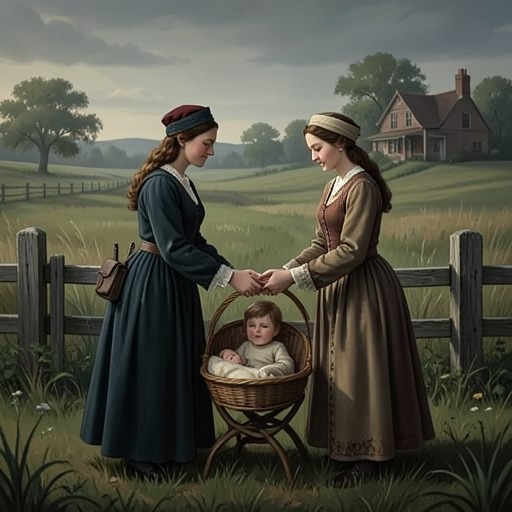
Ashley’s defining act occurs at the birth of his first child. When he learns that the baby is a girl, he orders that she be got rid of and threatens the household maid, Zillah, against speaking of what happened. He also says that a grave is to be prepared. The order reveals how far his demand for a son overrides his responsibility to a living child. Zillah ultimately saves the infant, but Ashley’s threat forces her to keep the truth from Lavinia. The baby grows up as Sunday Small, unaware of her birth family, while her mother remains unaware that she has a daughter.
The same contrast between heir-making and fatherhood appears when Lavinia gives birth prematurely to Stephen. Ashley enters the room while she is gravely unwell and the baby’s survival is uncertain. On learning that the child is a boy, he celebrates the news and turns at once to telling Mr Wilde, without looking at the infant. Zillah is left to warm and tend the fragile child. The long-awaited son fulfills Ashley’s stated objective, but his response makes clear that the achievement matters more to him as an inheritance secured than as a new relationship with a child.
After Stephen’s birth, Ashley’s uncle’s money is being disbursed. Lavinia understands that her husband’s interest in having a son was a means to that end, and she is relieved by the prospect that he will stay away. The birth has not repaired the marriage or awakened a paternal attachment. It has instead weakened Ashley’s practical need to press Lavinia further, while leaving her increasingly conscious of the selfishness behind his demands.
Loss, separation, and death
After Stephen dies, Lavinia tells Ashley that their son is dead and orders him to leave Treetops Manor. His first concern is what he will tell Mr Wilde, rather than the loss she is grieving. He then claims that the house and her property are his by right as her husband. Lavinia counters that her father had required him to sign an agreement before their marriage preserving her wealth as her own. That document gives her a means to enforce the separation Ashley assumes she cannot demand. She rejects his appeal to marital authority, and he leaves.
A later visit from a representative handling Ashley’s affairs confirms that he has been killed in a shooting accident in Ledbury. The circumstances include a liaison with the wife of the man whose gun went off, and the police are investigating. The report identifies Ashley as dead and tells Lavinia that, as his next of kin, she stands to inherit his estate. His death ends his ability to control or threaten her, but it also releases the secret Zillah has carried: she had feared revealing Sunday’s birth while Ashley was alive because of what he might do.
Narrative role and consequences
Ashley’s authority operates through money, marriage, threats, and the institutions that could be used against women who resisted him. Zillah fears that if she exposes the newborn’s survival, Ashley could have Lavinia declared insane and confined at Hatter’s Hall, while Zillah herself could be sent to the workhouse. His power therefore keeps the secret in place without his needing to appear in every later consequence of it. The life Sunday leads, and Lavinia’s years of believing herself childless, are bound to his order at the birth.
Once Ashley is dead, Zillah tells Lavinia that Sunday is her daughter. Lavinia recognizes the resemblance in their hair and eyes and recalls the special bond she had felt with the girl. The delayed disclosure changes the meaning of Ashley’s earlier attempt to erase his daughter: the child survived, and mother and daughter are eventually able to meet and reconcile. At the Mothering Sunday service, Sunday approaches Lavinia and offers her violets, addressing her as her mother. The reunion does not undo the years Ashley’s secrecy cost them, but it gives the story’s central family revelation a resolution that his threats had long prevented.